
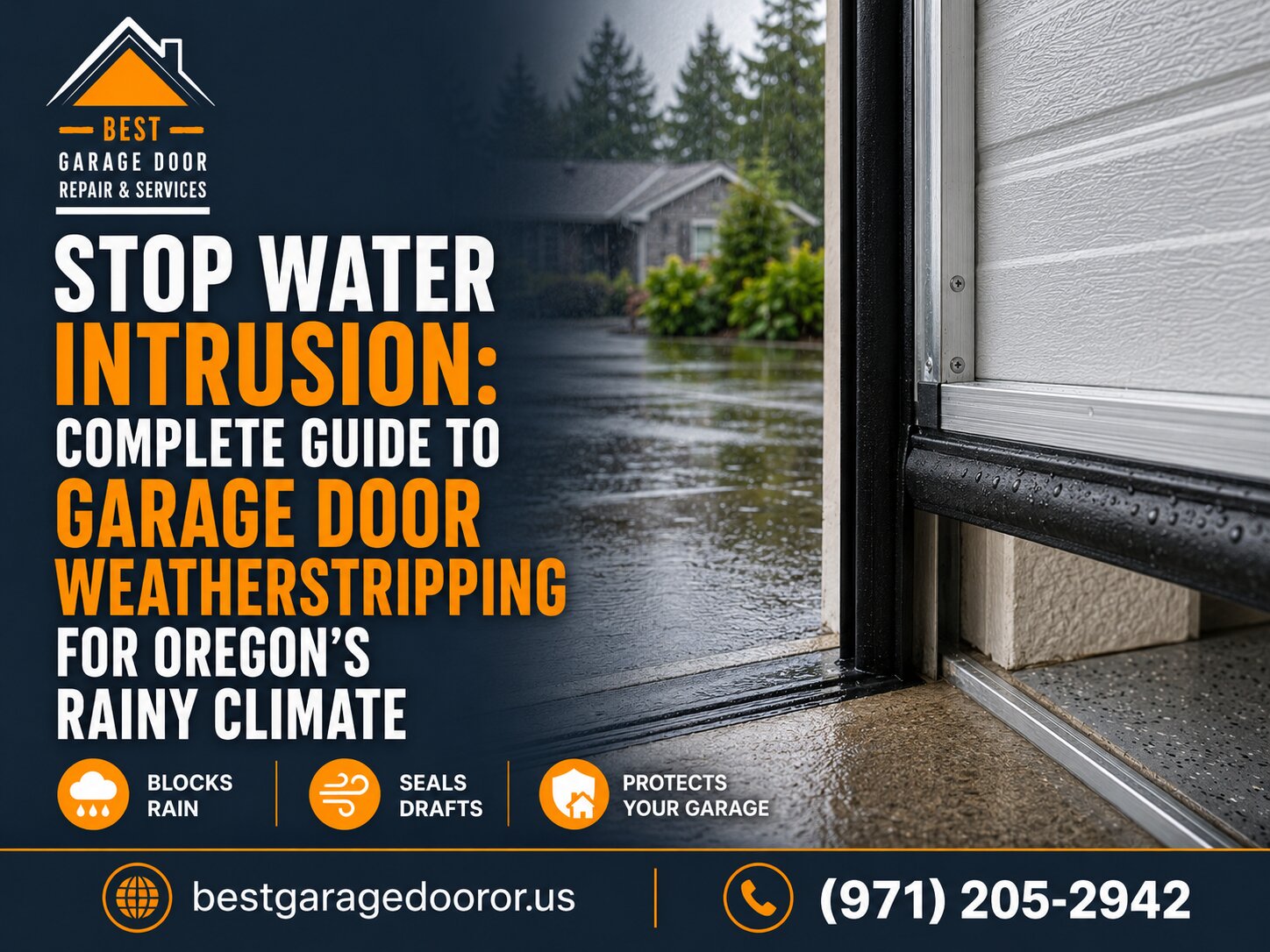
After working on garage doors throughout Hillsboro and the Portland Metro area for years, I’ve seen firsthand what our Pacific Northwest rain does to poorly sealed garages. Puddles creeping under your garage door, damp concrete floors in the Tanasbourne and Orenco neighborhoods, and water-damaged storage boxes are problems I encounter almost daily during our wet season.
The right weatherstripping and bottom seals make all the difference between a dry, functional garage and one that turns into a miniature reflecting pool every time it rains. I’m going to share exactly what works in our Oregon climate and what doesn’t, based on hundreds of installations our team has completed across Washington County.
Table of Contents
Why Standard Weatherstripping Fails in Pacific Northwest Conditions
Our climate is uniquely challenging for garage door seals. We don’t just deal with occasional rain, we face months of steady moisture from October through May, combined with mild temperatures that promote mold growth.
I’ve replaced countless vinyl seals that cracked after just one or two seasons. The problem isn’t always the material quality, it’s that many national brands design weatherstripping for climates with harsher freeze-thaw cycles or intense sun exposure, not our constant dampness.
What Type of Bottom Seal Works Best for Oregon Garages?
EPDM rubber bottom seals are the most effective choice for Pacific Northwest garages because they resist mold, maintain flexibility in wet conditions, and create a superior water barrier. After installing hundreds of different seal types throughout Hillsboro and surrounding areas, EPDM consistently outperforms vinyl, PVC, and basic rubber alternatives in our climate.
The key difference lies in how EPDM responds to constant moisture exposure. While standard vinyl seals become brittle and crack within 18 to 24 months in our wet environment, quality EPDM seals regularly last five to seven years with minimal maintenance, making them an excellent investment for Professional Garage Door Repair And Services in the Pacific Northwest.
Side and Top Weatherstripping That Actually Stops Wind-Driven Rain
Bottom seals get most of the attention, but I’ve diagnosed countless water intrusion problems in Hillsboro homes where the real culprit was failed side or top weatherstripping. When wind pushes rain horizontally during our winter storms, compromised side seals let water stream right into your garage.
We install T-style bulb weatherstripping on the sides and top of garage door frames throughout Washington County. This design features a bulb that compresses when the door closes, creating a tight seal that rebounds after each cycle.
Solving Common Hillsboro Garage Floor Challenges
Garage floors in older Hillsboro neighborhoods like Shute Park and Jackson School often have settling issues or deliberate slopes for drainage. These irregularities create gaps under standard bottom seals that allow water to pour through during heavy rain.
Our team addresses uneven floors differently depending on the severity of the problem. Minor irregularities (less than half an inch variation) respond well to adjustable bottom seals with thicker rubber profiles.
Installation Details That Make or Break Seal Performance
I’ve repaired too many DIY weatherstripping installations where quality materials failed prematurely because of installation mistakes. The most common error I see is not cleaning the mounting surfaces properly before installation.
Our technicians spend extra time on surface preparation because it directly impacts seal longevity. Oil residue, dirt, old adhesive, and moisture on mounting tracks prevent proper adhesion and create gaps where water infiltrates.
When to Choose Professional Installation Over DIY
Simple bottom seal replacement on a standard door with a flat, level floor is absolutely a DIY-friendly project. I encourage homeowners to tackle straightforward replacements if they’re comfortable with basic tools.
However, certain situations benefit significantly from professional installation. Our team brings specialized tools and experience that prevent costly mistakes on complex projects.
Professional installation makes sense when you’re dealing with sloped floors, installing threshold seal systems, addressing water problems that persist after seal replacement, working with custom or oversized doors, or combining weatherstripping replacement with other door repairs.
We also recommend professional service for homes with finished garage spaces or climate-controlled garages where proper sealing directly impacts energy costs. The precision installation our technicians provide typically pays for itself through improved energy efficiency.
Maintenance Schedule for Maximum Weatherstripping Lifespan
Quality weatherstripping isn’t a install-and-forget component. Regular maintenance significantly extends seal life and maintains water protection effectiveness throughout our long rainy season.
I recommend a simple quarterly inspection routine that takes less than 10 minutes but catches problems before they cause water damage.
Cost Considerations and Long-Term Value
Weatherstripping costs range dramatically based on material quality and system complexity. Basic vinyl bottom seals start around $20 to $30 for materials, while premium EPDM seals with aluminum retainers run $60 to $90.
Complete weatherstripping replacement including sides, top, and bottom typically costs $150 to $250 for materials on a standard two-car garage door. Professional installation adds $100 to $200 depending on door size and complexity.
I always encourage homeowners to think beyond initial cost. A $30 vinyl seal that fails in 18 months actually costs more over five years than a $75 EPDM seal that lasts the entire period.
Threshold seal systems represent a bigger investment at $200 to $400 installed, but they’re often the only effective solution for problem driveways with significant slope or settling issues. For homes in areas like Rock Creek where sloped driveways are common, this investment prevents thousands in potential water damage to garage contents and finished flooring.
Signs Your Weatherstripping Needs Immediate Replacement
Don’t wait for standing water to tell you that weatherstripping has failed. Several early warning signs indicate it’s time for replacement before you experience significant water intrusion.
Our Weatherstripping Service Throughout Washington County
We provide complete weatherstripping assessment, recommendation, and installation services throughout Hillsboro and surrounding communities. Our technicians carry quality EPDM seals, threshold systems, and all necessary installation materials on every service truck.
When you call us for weatherstripping service, we don’t just replace the failed component. We evaluate your entire door system, check for underlying issues contributing to premature seal failure, and recommend solutions matched to your specific situation and budget, just as we do when helping homeowners Troubleshoot Garage Door Sensor Problems in Tigard and Aloha.
Our team understands Pacific Northwest garage door challenges because we live and work here. We’ve installed weatherstripping on homes from modern Orenco Station townhomes to classic Witch Hazel Village properties, and we know what materials and methods deliver lasting results in our climate.
Protect Your Garage From Oregon Rain Today
Quality weatherstripping is your garage’s primary defense against our relentless Pacific Northwest rain. Whether you need a simple bottom seal replacement or a complete weatherstripping system overhaul, our team provides solutions that keep your garage dry year after year.
Don’t let another rainy season damage your garage contents, create mold problems, or force you to squeegee water after every storm. Contact us today for a professional weatherstripping assessment and keep Pacific Northwest rain where it belongs, outside your garage, or explore options for New Garage Doors if your current door is beyond simple weatherstripping repairs.


Leave A Comment